







Table of Contents
- What Is Structured Data in SEO?
- Why Structured Data Is Important for Search Visibility
- How Structured Data Helps You Rank in AI Overviews and LLMs
- Common Types of Structured Data Schema for SEO
- Article Schema (For Blogs & Content Pages)
- FAQ Schema (For Featured Snippets & AI Results)
- Organization & Local Business Schema
- Advanced Real-World Schema Examples
- Property Listing Schema (Real Estate SEO)
- Restaurant Schema (Food & Hospitality SEO)
- Event Schema (Webinars & Conferences)
- Product Schema (Even for Services)
- Review & Rating Schema
- How to Implement Structured Data (Step-by-Step)
- Step 1: Identify the Page Type
- Step 2: Choose the Right Schema Type
- Step 3: Create Schema Markup (3 Practical Methods)
- Method 1: Use an SEO Plugin (Beginner-Friendly)
- Method 2: Use Schema Generators (No Coding Required)
- Method 3: Manually Write JSON-LD Schema (Advanced Control)
- Step 4: Match Schema With Visible Content
- Step 5: Validate Your Structured Data
- Step 6: Monitor Performance in Search Console
- Best Practices for Structured Data SEO
- Common Structured Data Mistakes to Avoid
- Structured Data and Featured Snippets
- How Structured Data Fits Into a Complete SEO Strategy
- Final Thoughts
Structured data has become one of the most powerful yet underutilized SEO techniques. As search engines move toward AI-driven results, understanding how to use structured data to boost search visibility is critical for ranking in organic search, appearing in Google AI Overviews, and being referenced by Large Language Models (LLMs).
In this comprehensive guide, you’ll learn what structured data is, why it matters for SEO, and how to implement schema markup correctly to improve rankings, click-through rates, and AI visibility.
What Is Structured Data in SEO?
Structured data is a standardized format used to provide search engines with explicit information about your content. It helps search engines understand the meaning, context, and relationships within your pages.
Structured data is implemented using schema markup, most commonly in JSON-LD format, which is recommended by Google.

Why Structured Data Is Important for Search Visibility
While structured data is not a direct ranking factor, it plays a major role in how your content is interpreted and displayed in search results.
Benefits of Using Structured Data
- Enables rich results like FAQs, star ratings, breadcrumbs, and prices
- Improves click-through rate (CTR)
- Helps content appear in Google AI Overviews
- Supports voice search and answer engines
- Makes content easier for LLMs to understand and reuse
Search engines and AI systems rely heavily on structured signals to determine content relevance and authority.
How Structured Data Helps You Rank in AI Overviews and LLMs
AI-powered search experiences analyze content differently from traditional search. They prioritize:
- Clear definitions
- Entity relationships
- Consistent data structures
- Verified business and author information
Structured data strengthens semantic clarity, making your website easier for AI models like ChatGPT, Gemini, and Perplexity to understand, trust, and cite.
Common Types of Structured Data Schema for SEO
Article Schema (For Blogs & Content Pages)
Article schema helps search engines understand:
- Title and description
- Author information
- Publish and update dates
- Featured images
This schema is essential for blog posts and content marketing.
FAQ Schema (For Featured Snippets & AI Results)
FAQ schema allows frequently asked questions to appear directly in search results.
Benefits:
- Higher CTR
- Increased chance of AI Overview inclusion
- Strong voice search compatibility
Organization & Local Business Schema
Organization and LocalBusiness schema help define:
- Business name
- Logo
- Address and contact details
- Social profiles
- Business hours
These schemas build trust and authority, especially for service-based businesses.

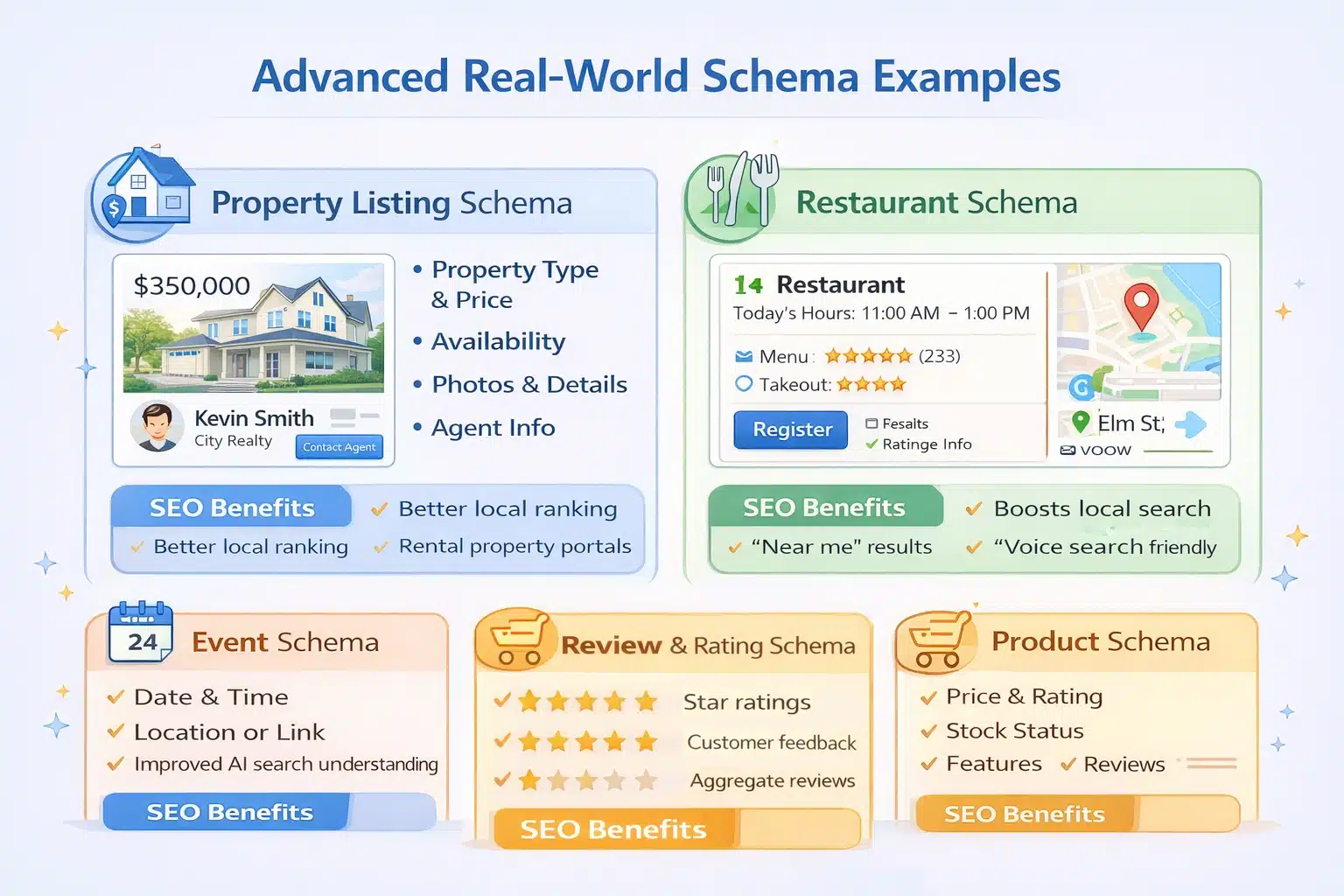
Advanced Real-World Schema Examples
Property Listing Schema (Real Estate SEO)
Property listing schema is ideal for:
- Real estate websites
- Rental property portals
- Commercial property listings
Information It Can Mark Up
- Property type and location
- Pricing and availability
- Images and features
- Agent or seller details
Benefits
- Better local visibility
- Enhanced indexing
- Improved AI search understanding
Common schema types
- RealEstateListing
- Place
- PostalAddress
- Offer
Restaurant Schema (Food & Hospitality SEO)
Restaurant schema is widely used by:
- Restaurants
- Cafes
- Cloud kitchens
- Food delivery services
Data Covered
- Menu and cuisine type
- Opening hours
- Price range
- Reviews and ratings
- Location details
SEO Benefits
- Better local pack rankings
- Improved “near me” search results
- Voice search compatibility
Schema types
- Restaurant
- Menu
- AggregateRating
Event Schema (Webinars & Conferences)
Event schema helps promote:
- Webinars
- Workshops
- Conferences
- Online events
Key Data Points
- Event date and time
- Location or virtual link
- Organizer
- Ticket availability
This schema increases visibility and engagement in search results.
Product Schema (Even for Services)
Product schema is not limited to physical products.
You can use it for:
- Software tools
- Digital services
- Subscription plans
- Online packages
Benefits
- Enables rich results (pricing, reviews)
- Increases CTR
- Strong compatibility with AI search
Review & Rating Schema
Review schema adds trust signals by displaying:
- Star ratings
- Customer feedback
- Aggregate reviews
This significantly improves CTR and credibility.
How to Implement Structured Data (Step-by-Step)
Step 1: Identify the Page Type
Determine whether the page is a:
- Blog post
- Service page
- Product page
- Listing page
Step 2: Choose the Right Schema Type
Once you identify the page type, the next step is selecting the correct schema markup that matches the page’s intent.
Common Page Types and Recommended Schema
- Blog post → Article or BlogPosting
- Service page → Service
- Local business page → LocalBusiness
- Product or package page → Product + Offer
- FAQ section → FAQPage
- How-to guide → HowTo
Choosing the correct schema ensures search engines and AI systems understand what the page represents, not just what it says.
Step 3: Create Schema Markup (3 Practical Methods)
There are three reliable ways to create structured data, depending on your technical comfort level.
Method 1: Use an SEO Plugin (Beginner-Friendly)
If your website runs on WordPress, SEO plugins are the easiest way to create schema.
Popular options:
- Rank Math
- Yoast SEO
- Schema Pro
How This Works
- Open the page or post editor
- Select the schema type (Article, Service, FAQ, etc.)
- Fill in required fields like title, description, author, or service details
- Save and publish
Best for: Bloggers, business owners, non-developers
SEO benefit: Clean, error-free schema with minimal effort
Method 2: Use Schema Generators (No Coding Required)
Online schema generators allow you to create JSON-LD code by filling out a form.
You simply:
-
- Choose the schema type
- Enter page details (title, business name, service, FAQs, etc.)
- Generate JSON-LD code
- Paste it into your page’s <head> or footer
Best for: Custom pages, advanced SEO control
SEO benefit: Full flexibility and clean structured data
Method 3: Manually Write JSON-LD Schema (Advanced Control)
JSON-LD is Google’s recommended structured data format.
You manually write schema using:
- @context
- @type
- Defined properties (name, description, provider, offers, etc.)
This method gives maximum control and is ideal for:
- Large websites
- Custom frameworks
- Advanced SEO projects
Best for: Developers & advanced SEO professionals
SEO benefit: Precise entity relationships for AI & LLMs
Step 4: Match Schema With Visible Content
One of the most common mistakes is adding schema that does not match on-page content.
Best Practices
- Schema data must reflect visible text
- Do not mark up hidden content
- Prices, FAQs, and services must exist on the page
- Keep information accurate and updated
Search engines and AI systems cross-verify schema with page content.
Step 5: Validate Your Structured Data
Before publishing, always validate your schema.
Recommended Testing Tools
- Google Rich Results Test
- Schema Markup Validator
Validation ensures:
- No syntax errors
- Eligibility for rich results
- Proper AI interpretation
Step 6: Monitor Performance in Search Console
After implementation:
- Check Enhancements reports
- Monitor CTR changes
- Track impressions for rich results
- Fix any warnings or errors
Structured data performance improves over time as search engines reprocess your pages.
Best Practices for Structured Data SEO
- Use only relevant schema types
- Match schema data with visible content
- Avoid keyword stuffing in markup
- Keep schema updated
- Combine schema with quality content
Common Structured Data Mistakes to Avoid
- Adding schema to irrelevant pages
- Using incorrect schema types
- Marking hidden content
- Ignoring validation errors
- Overusing review schema
Structured Data and Featured Snippets
Structured data improves eligibility for:
- Featured snippets
- AI Overviews
- Voice search answers
To increase chances:
- Use clear headings
- Add FAQs
- Answer questions concisely
- Support answers with schema markup
How Structured Data Fits Into a Complete SEO Strategy
Structured data works best when combined with:
- On-page SEO optimization
- Internal linking
- Fast page speed
- Mobile-friendly design
- High-quality content
It enhances visibility but does not replace SEO fundamentals.
Final Thoughts
Structured data is no longer optional. It is a critical SEO component for ranking in organic search, appearing in AI Overviews, and being recognized by LLMs.
By implementing schema markup correctly, you help search engines and AI systems understand who you are, what your content means, and why it deserves visibility.
Looking to launch or scale a full SEO project? TechnoCrackers delivers end-to-end SEO solutions including technical optimization, structured data implementation, content strategy, and authority building to grow your organic traffic and AI search presence.